
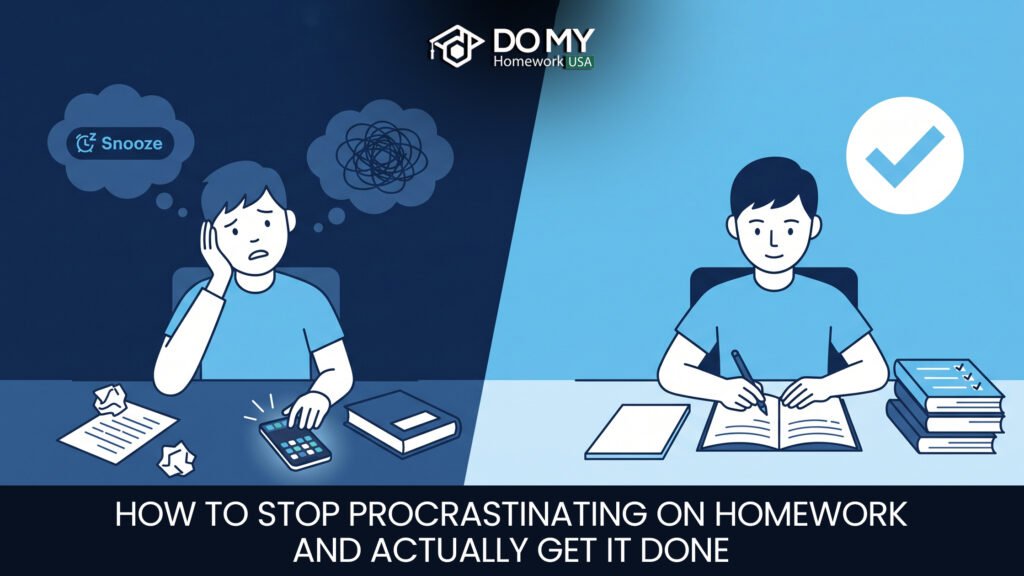
How to Stop Procrastinating on Homework and Actually Get It Done
Your homework is open on the desk. Your phone is in your hand. You check one message, then another. You watch a short video and check social media. Suddenly, an hour has passed, but the first question still waits for you. Many USA students know this situation all too well. The problem is not always a lack of effort. Often, the real issue is knowing how to stop procrastinating on homework when starting feels harder than the work itself.
Procrastination can make a simple assignment feel much bigger. The longer you wait, the more pressure builds. Then, you rush through the work and feel disappointed afterwards. The good news is that you can break this pattern. You do not need to become a different person. You need to understand what causes the delay and use practical steps that make starting easier.
Why Do Students Procrastinate on Homework? The Real Reasons
So, why do students procrastinate when they already know the work needs attention? Laziness is not always the answer. Fear of failure can make an assignment feel threatening. A student may worry about getting the wrong answer or receiving a low grade. Avoiding the assignment then provides temporary relief. That relief can reinforce the habit and make starting harder next time.
Feeling overwhelmed creates another common barrier. A paper with several requirements may seem impossible when viewed as one task. Perfectionism can also cause delays. Some students want every sentence or answer to be perfect. Uninteresting subjects create another challenge. Mental fatigue also matters after a long school day. Finally, unclear instructions can leave students unsure about their first step.
Research has found that procrastination is widespread among college students. Studies often report rates between 80% and 95%. That does not mean every student procrastinates constantly. It shows that delaying academic tasks is a common experience. Recognising this can remove some unnecessary shame. The goal is not to judge yourself. The goal is to understand your pattern and change it.
How Homework Procrastination Hurts More Than Just Your Grades
Delaying homework can affect much more than your report card. When an assignment remains unfinished, it stays in the back of your mind. That unfinished task can create ongoing stress. Students may also lose sleep while trying to finish several assignments late at night. Rushed work can contain more mistakes and may not reflect the student’s actual ability.
Research on academic procrastination also connects frequent delay with poorer academic outcomes. It can also relate to greater stress and reduced well-being. The pattern often becomes circular. You delay the assignment, feel guilty, and become more stressed. That stress makes the next task feel even harder. Breaking the cycle early can protect both your time and your peace of mind.
Understand Your Procrastination Type Before Trying to Fix It
Not every student delays homework for the same reason. Understanding your type can help you choose a better solution. Some students avoid work because they feel anxious or uncertain. Others intentionally wait because they believe pressure helps them perform. These patterns may look similar from the outside. However, the reason behind the delay can change the best approach to homework procrastination.
Anxiety-Driven Procrastination
An anxious student may stare at a blank document for thirty minutes. They know what the teacher expects, but they fear doing it incorrectly. Breaking the assignment into tiny steps can help. Starting with research or a rough outline removes some pressure. The first version does not need to be perfect. It only needs to give the student something to improve.
Pressure-Seeking Procrastination
Another student may say, “I work better under pressure.” They might wait until Sunday night before starting a Monday paper. The deadline creates excitement and forces quick decisions. This approach can sometimes produce finished work. However, it can also create unnecessary stress. Earlier mini-deadlines can provide the same sense of urgency without requiring an all-nighter.
How to Motivate Yourself to Do Homework When You Simply Don’t Want To
Motivation does not always arrive before action. In many cases, action creates motivation. Waiting until you feel ready can keep you waiting for hours. Instead, make the first step extremely small. This approach reduces the mental resistance that shows up before difficult work.
Use the Five-Minute Rule
Remind yourself that you don’t have to work for more than 5 minutes. Open the assignment and work on a small section. You may read one page and solve one question or write 3 sentences. After five minutes, you can decide if you would like to continue or not. For most students, it is easier to continue when they are already doing so.
Connect the Assignment to Your Goal
Think about what completing the assignment helps you achieve. A good grade can be used to boost your overall average. You might have extra time for your friends or hobbies if you finish first. Linking the work to personal values adds meaning to the work at hand. This makes how to motivate yourself to do homework feel more practical.
Give Yourself Small Rewards
Rewards can make repetitive schoolwork easier to manage. Finish one section, then take a short break. Complete your problem set, then watch an episode later. Keep rewards small and predictable. Avoid turning a five-minute break into an hour of scrolling. Your reward should help you stay consistent, not restart the procrastination cycle.
If an assignment feels especially difficult, students may also look for additional academic options. Some may search for services that let them do my homework for me. The important thing is choosing support that helps them understand and manage their academic responsibilities.
Practical Steps to Start Your Homework When Procrastination Kicks In
Starting becomes easier when you remove decisions from the process. First, close unrelated browser tabs. Put social media and messaging apps away. Then write down exactly what you need to complete tonight. Avoid writing “do homework” because that feels too broad. Instead, write specific actions such as “read pages 20–25” or “answer questions one through five.”
Next, choose the smallest task. Starting with one easy question can create momentum. Set a timer for 20 to 25 minutes. Work only on the selected task during that period. When the timer ends, take a short break. Stand up, stretch, drink water, and return to your desk. Starting often feels like the hardest part. Once you begin, continuing usually requires less effort.
How to Focus on Homework and Stay on Task Until It’s Done
Sitting at a desk does not automatically mean you are focused. Real focus means giving one task your attention without repeatedly switching activities. Start by turning off unnecessary phone notifications. If possible, put your phone across the room. A website blocker can also limit distracting sites during your study period.
Create a study space that supports your routine. Keep your books, laptop, charger, and water nearby. This reduces unnecessary trips away from your desk. Some students prefer complete silence. Others concentrate better with quiet background sounds. Choose whichever environment helps you work comfortably. When learning how to focus on homework, remember that multitasking usually creates more interruptions.
Even a quick phone check can break your concentration. You may spend only two seconds reading a notification. Your mind can still shift away from the assignment. Returning to the same level of concentration can take much longer. Give each task your full attention for a short period. Focused twenty-minute sessions can be more productive than hours filled with constant interruptions.
How to Stop Procrastinating on Big or Complex Assignments
Large assignments create a special problem. The final goal feels far away, while the first step may seem unclear. A research paper provides a good example. “Write a ten-page paper” sounds much harder than several smaller tasks. You can make the project manageable by creating a clear path from the beginning.
Start by defining the final deliverable. Then identify every step needed to complete it. For a research paper, those steps might include choosing a topic, finding sources, creating an outline, writing sections, revising, and proofreading. Give each step a realistic amount of time. Finally, place those steps across the days you have available.
Working for 30 minutes each day can change the entire experience. You might research on Monday and create an outline on Tuesday. Wednesday can focus on the introduction and first section. The remaining sections can follow on later days. This approach reduces pressure and leaves room for unexpected problems. It also gives you time to improve your work before submission.
When Procrastination Is a Sign You Need Help with the Subject
Sometimes procrastination has little to do with time management. You may avoid homework because you genuinely do not understand the subject. Imagine opening a chemistry assignment and not knowing which formula applies. Starting feels difficult because you lack the information needed to begin. In this situation, another productivity technique may not solve the real problem.
Subject-specific support can make a much bigger difference. Ask your teacher about confusing instructions or difficult concepts. You can also study with a classmate who understands the topic. School tutoring services can provide another useful option. Online resources may also help explain challenging material in simpler terms. Quality online homework help can support students when they need guidance with a specific subject.
Getting help does not mean you cannot handle your studies. It means you recognise when you need clearer explanations. Once the confusing part makes sense, the assignment often feels much easier. You can then work independently with greater confidence. The key is addressing the actual barrier instead of blaming yourself for delaying.
Build a No-Procrastination Homework Routine That Actually Sticks
Long-term change becomes easier when homework follows a predictable routine. Choose a realistic start time that fits your school schedule. You might begin shortly after dinner or after a short rest. Try to use the same workspace whenever possible. Familiar surroundings can signal that it is time to focus.
Before starting, spend two minutes reviewing your tasks. Decide what needs immediate attention and what can wait. Choose your first task before opening social media or entertainment apps. Set a clear end time as well. Knowing when you can stop makes homework feel less endless.
A routine also reduces decision fatigue. You do not need to debate every evening about when or where to work. The routine makes the starting process more automatic. It should still leave room for sports, clubs, family time, and friends. A realistic schedule is easier to maintain than a strict plan that leaves no flexibility.
Final Thoughts on How to Stop Procrastinating on Homework
Procrastination is not a character flaw. It is a habit that can change with awareness and practice. The first step is understanding what causes your delays. Fear, confusion, tiredness, perfectionism, and boredom can all create resistance. Once you recognise the reason, you can choose a strategy that addresses it.
Learning how to stop procrastinating on homework does not require perfect discipline. Start with five minutes, break large tasks into smaller steps, and protect your focus. Build a routine that fits your real life. Most importantly, do not wait for motivation to magically appear. Take one manageable action first. For USA students balancing classes, activities, work, and personal life, small consistent steps can make homework feel much more manageable.